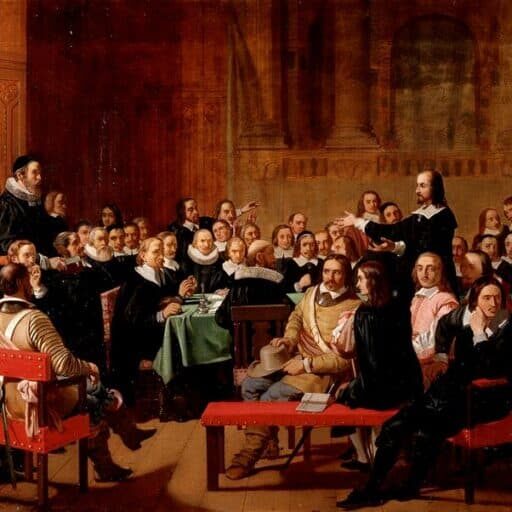

Strawed Upon the Water: The Scripture Law of Preaching
This article is a brief Scriptural response to Rev. Ryan Denton’s article: “Expository Preaching, The New Golden Calf” posted on Reformation 21’s website on May 12, 2025. 1 This will not be an exhaustive treatment of the topic, but will simply engage with Rev. Denton’s article, engaging in exposition of the Scripture law of preaching. Your authors, Rev. Adam Brink (pastor, Shenandoah Valley Reformed Presbyterian Church) and Rev. Dr. Todd Ruddell (pastor, Christ Covenant Reformed Presbyterian Church) pray that their humble efforts will be of use to our brethren in Christ.
Beginning with the title of the article, Rev. Denton has introduced the image of idolatry at Sinai, recorded by Moses in Exodus 32:4-8:
And he received them at their hand, and fashioned it with a graving tool, after he had made it a molten calf: and they said, These be thy gods, O Israel, which brought thee up out of the land of Egypt. 5 And when Aaron saw it, he built an altar before it; and Aaron made proclamation, and said, To morrow is a feast to the LORD. 6 And they rose up early on the morrow, and offered burnt offerings, and brought peace offerings; and the people sat down to eat and to drink, and rose up to play. 7 And the LORD said unto Moses, Go, get thee down; for thy people, which thou broughtest out of the land of Egypt, have corrupted themselves: 8 They have turned aside quickly out of the way which I commanded them: they have made them a molten calf, and have worshipped it, and have sacrificed thereunto, and said, These be thy gods, O Israel, which have brought thee up out of the land of Egypt.2
From the exposition of this text, we understand that the Israelites were attempting to worship the true God by false, syncretistic means, mingling a worship-form they saw practiced in Egypt, the worship of the bull-god Apis, with the worship of the true God, Jehovah. Rev. Denton posits that expository preaching is a new golden calf, or idolatrous way to worship the true God. Thus, in order for the eye-catching title of Rev. Denton’s article to carry any weight, he must demonstrate, not merely that Chrysostom or Martin Lloyd-Jones used a specific methodology in preaching, but that God Almighty commanded by His holy Apostles and Prophets that such a method is the only God-sanctioned method, and that all deviations from such a method are a casting aside of divine authority, idolatrous, and a corruption of God’s law of preaching. We believe he does not accomplish his end.
Our first difficulty, stated clearly, is that our brother seeks throughout his article to instruct ministers and members of the Church on proper preaching without ever turning to the Scriptures. As Presbyterian Ministers, vowing the Westminster Confession of Faith to be the confession of our own faith, the authors of this response uphold this particular truth: “But the acceptable way of worshipping the true God is instituted by himself, and so limited by his own revealed will, that he may not be worshipped according to the imaginations and devices of men, or the suggestions of Satan, under any visible representation, or any other way not prescribed in the holy scripture.”3 Preaching being an element of worship, it too is to be informed by Scripture. “What makes good preaching?” This is the question Rev. Denton is asking and attempting to answer in his article.
Our Confession declares that the Scripture law of worship brings that element of worship under the purview of the voice of Christ as the Son over the house. It is of no light moment then that we find no Scripture quoted, nor any text exposited to inform preachers how they ought to preach in our brother’s article. Throughout the article Rev. Denton continues with the “nice idea” approach. None of the points he makes has been substantiated with “thus saith the Lord.” The ideas pressed as law for preachers are given by example, according to preference. The points regarding exegesis, clarity, structure, etc. being amicable to faithful preaching may or may not be true. But for a divine law to be pressed on the conscience of so many ministers of the gospel (presumably Rev. Denton’s target audience), more is required than presumption of certain nice ideas, or well-meaning assertions, or generally accepted truisms from seminaries. What is necessary is, “thus saith the LORD.”
The preaching of Lloyd-Jones, Spurgeon, Chrysostom, Edwards, Davies, etc. is set forth as commendable, and an example of unction, pleading, wooing, etc. for every minister. What is necessary for good preaching is “unction, pleading, and prayer,” largely absent from homiletic curricula in the present day, according to our brother. But never is the preaching of these men held up to Scripture, the only rule of faith and obedience, and judged by the infallible Word, and thereby brought forth as commendable. Instead, Rev. Denton introduces new, nice ideas that he finds under-emphasized in his own experience. He seems to prefer what your authors call the Romantic strand of preaching.4 This was arguably present in some of the church fathers (though we are uncertain about it being as present in Chrysostom as he asserts, when compared to Spurgeon or Lloyd-Jones). However, as many New Lights and New School preachers have done in the past, Rev. Denton makes no Scripture assertion or argumentation showing that true preaching (according to Scripture) requires a central focus upon emotional appeals such as pleading or wooing.
Regarding prayer and preaching, he certainly could have cited Scriptures that require all believers to pray without ceasing, and added as an inference that if Paul petitioned others to pray for him concerning his own preaching,5 that he would pray along those same lines. It is troubling that our brother gives no instruction from Scripture, and never seems to sense the need to do so, but asserts these preferences only from his own observation and review of sermons from preferred authors. Regarding apostolic injunctions respecting the biblical law of unction and pleading as the sine qua non of lawful preaching (vs. golden calf preaching) our brother is silent. If Rev. Denton’s assertions are correct, without such characteristics in a sermon, it is rife with false teaching, which entails several sins: violation of ordination vows, bearing false witness, Sabbath breaking (when false preaching takes place on the Sabbath), and taking God’s Name in vain by lying while pretending to preach truly in God’s Name.
The second difficulty presented in the article is what we understand to be a false dilemma. Stated concisely, our brother writes, “We have taught our men to expound the Word but not necessarily to preach it. We have trained them to analyze the text, but not to apply it with urgency. And so, we have traded emotionalism for sterility. We have insisted on doctrinal depth but have neglected the spiritual burden that must accompany it.”
And again, “We need teaching, but teaching is not preaching. Preaching is heralding. Preaching is confronting. Preaching is pleading. Preaching is not the delivery of data, but a divine summons. It is an urgent call from heaven to earth, issuing from a man who has felt the weight of eternity and has come to speak on behalf of the Living God. That’s experiential preaching. It is preaching that aims not merely at the intellect, but at the heart. It is preaching that exposes sin, exalts Christ, and calls the hearer to respond. It is preaching that dares to say, ‘You must be born again,’ not just, ‘Here is what the doctrine of regeneration means.’”
This gets more to the heart of Rev. Denton’s thesis. It appears that he assumes that exposition and preaching are distinct activities. To make this case would require some level of argumentation, exegesis, and logical analysis of several texts of Scripture, interacting with lexicons, and other labor to form a substantial argument, but sadly, such is not to be found in this article. Noah Webster defines the word expound as follows: “To explain; to lay open the meaning; to clear of obscurity; to interpret; as, to expound a text of scripture; to expound a law.” The Latin verb Webster cites is “expono”, or I set out. This Latin verb was used by Jerome’s Vulgate in Acts 11:4 and 28:23 regarding the labors of Peter and Paul. The Greek verb for expound, ἐκτίθημι ektithēmi, is used of Priscilla and Aquila’s expounding the way of God more perfectly to Apollos (18:26). The passage used regarding Paul (Acts 28:23) is instructive in that it correlates with various other verbs in context:
And when they had appointed him a day, there came many to him into his lodging; to whom he expounded and testified the kingdom of God, persuading them concerning Jesus, both out of the law of Moses, and out of the prophets, from morning till evening.
Thus, when looked at from the perspective of ministerial labors, exposition seems hard to distinguish from testifying and persuading. These two verbs generally describe the action of preachers or others that declare the law or the gospel. Testify, for example, is used of Peter’s preaching on Pentecost (Acts 2:40), is used alongside preaching in Philip’s case (Acts 8:25), is used as a synonym in Peter’s sermon to Cornelius (Acts 10:42), etc. Other passages include Acts 18:5, 20:21, 24, 23:11, 1 Thessalonians 4:6, 2 Timothy 2:14, in which it is abundantly clear that to testify is virtually to preach. And to expound, likewise, is virtually indistinguishable from the task of the minister to preach.
Coupled with the verb “persuade,” and the case for exposition being virtually identical to preaching is a shut case. The verb generally means to agree, to trust, or to persuade or be persuaded by argumentation. As such, Paul and Barnabas “persuaded [those at Pisidian Antioch] to continue in the grace of God,” (Acts 13:43). In Acts 17:4 it is used of those that believed Paul’s reasoning from Scripture, opening and alleging of specific doctrines from the text of Scripture at Thessalonica. Paul also reasoned and persuaded at Corinth (18:4), disputed and persuaded at Ephesus (19:8).
All this to say that the work of exposition is pastoral work. It is a virtual synonym in the language of the Holy Ghost in Scripture to persuasion, testifying, reasoning, opening, alleging, etc. And we present this on the authority of Scripture, not from a nice idea that we wish to foist on other ministers’ consciences. When our brother writes, “Exposition alone is not preaching. That is teaching. Preaching is more than the delivery of biblical data,” he presents his false dilemma, and presents a view of Scripture that does not rise to the Reformed conception of it. The Reformed Church has, since its departure from Rome, presented to all who would hear the high view of Scripture as God’s Word, above all other “words” in this world. To speak in terms of “biblical data” and its delivery is to treat the Bible with less honor than our Reformed Fathers did. Let us remember the “data” of Scripture: Inspired history; prophetic pleading, correction, conviction and comfort; lofty doctrine, teaching, prayer, praise, and many other forms of “biblical data” that are breathed out by God, filled with unction, and if presented faithfully, expounded truly, are able to make one wise unto salvation. It is the task of the preacher to herald not his own message, but the message of another, to herald the Word of the Lord, the “data,” information, propositions, and good and necessary applications of God. That teaching and preaching are virtual synonyms in the New Testament is clear. Let us look over the verbs used in the New Testament to describe ministerial functions.
This is clear in the Synoptic Gospels concerning our Lord’s ministry in Matthew 4:23:
And Jesus went about all Galilee, teaching in their synagogues, and preaching the gospel of the kingdom, and healing all manner of sickness and all manner of disease among the people.
The parallel passage in Mark 1:39 says:
And he preached in their synagogues throughout all Galilee, and cast out devils.
Thus, in terms of the Word of God, the sharp divide Rev. Denton and other Romantics may make between preaching and teaching is suspect, overstrained, or merely contrary to the God-breathed usage of such terms.
The description of Paul’s ministry at Rome in Acts 28:30–31 uses the verbs preach and teach interchangeably:
And Paul dwelt two whole years in his own hired house, and received all that came in unto him, 31 Preaching the kingdom of God, and teaching those things which concern the Lord Jesus Christ, with all confidence, no man forbidding him.
Here it is abundantly evident that the couplets of “kingdom of God” and “things which concern the Lord Jesus Christ” and “preaching” and “teaching” are meant as literary parallels for emphasis. As in the synoptics, so in Acts, preaching and teaching are not starkly contrasted activities, but essentially parallel activities. For a more detailed analysis of the activity of ministers, the various terms of the New Testament could be exhaustively handled, noting especially the parallel usages made of verbs like “preach the gospel,” “declare,” “reason,” “dispute,” “teach,” “dialogue,” “persuade,” “defend,” “speak boldly,” “speak,” “exhort,” “disciple,” “instruct,” etc.
The third objection is another false dilemma presented in the article, that which pits the intellect against the heart. Despite the modern distinction between the “head” and the “heart,” Scripture reveals that the heart thinks, reasons, debates, recalls, etc. This is not to deny that there are secondary acts of the heart in Scripture, by which the heart wills or chooses. Nor the tertiary acts of the heart in Scripture (very infrequently by the sum total of the Old and New Testaments) by which it feels or is moved with affection. The largely intellectual function of the heart is illustrated for us in the Gospel of Luke where the heart is turned by preaching (1:17), thinks (1:51, 9:47), lays up sayings (1:66, 2:51), ponders (2:19), has thoughts (2:35), muses or dialogues (3:15), can be wounded and healed (4:18), reasons (5:22), treasures and speaks (6:45), the word is retained or snatched from it (8:12), is used as a synonym for the soul and mind (10:27), sets its choice and attention on certain treasures (12:34), and holds internal dialogue (12:45), etc.
From these examples, it seems abundantly clear that what man is at his core is most definitely NOT his emotional state, appealed to by revivalists and other moderns. Man is, at his core, in his heart, what he thinks. A broken heart, according to Scripture, is not one moved with passion or affection, but a mind whose thoughts have been turned upside down, whose conscience condemns, and whose repentance (or change of mind) moves him to turn from sin unto God, in hope of the preached Christ, ready for all holy obedience. And the gateway that God has made in man’s soul to all of these glorious gospel realities is the heart, or the rational faculty, with a rational will subordinated to it.
The biblical usage of the reality of the human heart is why preaching and teaching are synonyms rather than antonyms in the New Testament. This further explains why Christians are generally referred to as “disciples,” learners, or students, and why the apostolic practice was to reason, persuade, dialogue, dispute, open and allege, exposit, speak, and declare from the text of Scripture. These truths indicate not a distinction between the heart and the intellect but bring them together.
Further, we disagree with the idea that it is anything other than the Word of God itself, brought home to the hearer by the Spirit of God, that “wounds, and heals.” The thought that it is the preacher and his delivery, rather than the Word and Spirit, which moves the hearer to this necessary wounding and binding up, should be abhorrent to all students of the Scripture. It is the data of Scripture, “dumped” upon the soil of the inner man—heart, mind, soul, by the Spirit of God, that causes implantation and fruit. It is only in this way that the hearer is apprised of his abiding death and cursedness (wounding) and only then the balm of Christ’s mercy and forgiveness is the means of his binding up.
We, with Rev. Denton, decry the emotional appeals that pass for preaching in the modern Church, where Scripture content is wanting. This lifeless kind of communication is condemned in Scripture, no matter how animated, urgent, and apparently quickened, in the preachers that preach it, and in the people that desire it.6 “Fables” can be effectively and experientially communicated, but are still lifeless. But we also fear that our brother is introducing another kind of emotional appeal instead, rather than the necessary work of study, Scripture exposition, and communication of divine, life-giving truth. For our part, not only is the Scripture a deep to be mined (being the very Word of God) but seeing that we are 2,000-3,500 years removed from its historico-societal context requires much in the way of study, effort, in the use of the ordinary means of exegesis, history, language, comparing Scripture with Scripture, to bring the full and true light of its message (all the counsel of God) to those who hear. Our Lord declared that His words are spirit, and are life.7 Deadness cannot be found where Scripture is truly exposited and brought out in truth. With many of our fathers in the faith, we recognize the primacy of the intellect, and forming the affections in keeping with the truth understood, and digested properly. Your authors are not opposed to holy affections, praying for them for ourselves and our hearers. However, affections cannot lead—when they do much mischief follows. They must be brought to heel to the knowledge and light given in the Word of the Lord.
The fourth objection has to do with the case our brother makes for homiletics generally, advocating for what he calls “experiential preaching” over other forms that he calls “lecturing,” “teaching,” “exegesis.” Hear him in his own words:
“Today, that ratio has largely been reversed. Most sermons I hear are about 90% exegesis, 10% application—if that. The focus is to convey information, parse Greek verbs, outline historical context, and deliver doctrinal precision. Again, none of these are bad. We need doctrinal clarity. We need rigorous exegesis. But if preaching becomes little more than a theological lecture, we have missed the point entirely. Paul did not charge Timothy to ‘exegete the Word,’ but rather to preach it. And there is a world of difference between the two.”
And again:
“We need teaching, but teaching is not preaching. Preaching is heralding. Preaching is confronting. Preaching is pleading. Preaching is not the delivery of data, but a divine summons. It is an urgent call from heaven to earth, issuing from a man who has felt the weight of eternity and has come to speak on behalf of the Living God. That’s experiential preaching. It is preaching that aims not merely at the intellect, but at the heart. It is preaching that exposes sin, exalts Christ, and calls the hearer to respond. It is preaching that dares to say, ‘You must be born again,’ not just, ‘Here is what the doctrine of regeneration means.’”
For our part, we believe that sound preaching is bringing out the text of Scripture in an understandable and applicatory way, that good preaching sounds like the Bible—the Bible made accessible to the hearers, the whole Bible, in the Bible’s own proportioned emphasis. Rev. Denton’s distinctions between teaching and preaching, the intellect and the heart are constructs that moderns have made in order to introduce irrational constructs. Such false distinctions make real dialogue over such matters difficult, since the “infinite passion” of this position makes it nearly impossible rationally to evaluate and be persuaded to a better mind. To question “experimental preaching” is often viewed as an act of impiety, since it touches the core of the appealing to the affections primarily.
But, as shown above, the heart is the intellect, and preaching is a parallel term in the New Testament for teaching. Disciples or learners are made by reasoning, declaring, debating, disputing, defending, expositing, teaching, and preaching.
Rev. Denton’s point that calls to regeneration are to be issued from the pulpit as well as a doctrine of regeneration is a sound one, not because of any nice idea, but because in one text of Scripture the call is issued to a sinner, and faithful exegesis informs the preaching. In another text, the doctrine of regeneration is explained, and faithful exegesis shapes the preaching as well. Some texts are legal, commanding. Some texts are evangelical, promising. Some texts are theoretical, speaking of God’s sublime attributes, and our adoration. Some texts are practical, working out our salvation. Some texts urge. Some texts inform. Some texts data-dump. Some texts rebuke. Exegetical preaching and teaching, by a divine law, MUST be shaped by the text, and in proportion to the whole. The Apostle Paul said to the Ephesian Elders at Miletus that he was free from the blood of all men because he had not shunned to declare unto them “all the counsel of God.”8 Citing Ezekiel 3:18-21, and 33:2-9 in application to himself, and following his example we do well to take to ourselves, that in preaching “all the counsel of God” we acquit ourselves as watchmen on the walls, warning the wicked to turn from his wickedness and turn to the Lord. We do not have the option of anything less.
In homiletics, the definition of idolatry is to espouse a theory and practice of preaching that is something other than what the Lord in His Word teaches us. As we have seen, exposition cannot be called idolatry, because it is Scripture-text driven. Rather than human-devised arbitrary proportions of application vs. exegesis or exposition, doctrine and intellect vs. affection, let us return to the liberty 9 which the Scriptures proclaim in our obedience to that true Prince of Preachers, Christ Himself, speaking in His Word. More specifically, if the epistles of the New Testament, or the extant sermons of the Apostles or apostolic men of the New Testament were analyzed along these lines of proportion it would be difficult to establish this 90/10 rule from the New Testament. Romans, for example, presents 11 chapters on doctrine and five on application (31/69). Ephesians offers three on doctrine, three on application (50/50). Other Epistles have varying degrees of application vs. theory. For an instance of Puritan sermons, one may find a similar variety, depending on the topic, the training of the minister, or the audience he is addressing. Some run in a more doctrinal track, others in a more practical. However, even if we conceded a 90/10 rule in the Puritans, what of it? Are the Puritans a rule to a minister’s conscience? Do they determine the Scripture law of preaching? Is a deviation from their method really a sin on par with worshipping the golden calf? Is there not one Lawgiver and Judge only? Is it possible that some ministers have refused to follow the flow of the text by a dogged adherence to lecturing when a text requires otherwise? Yes, indeed, that is certainly possible and actual. We all must work on refining our craft. But the proper response is not to fall into an opposite error, and that especially by arbitrary, romantic rule making.
In preaching this whole counsel of God, calls to repentance, instruction in righteousness, theology proper, offers of grace by Christ, the majesty of the Triune God, in other words, the whole catalog of Christian divinity will be taught to the people of God, to their edification and salvation. Rev. Denton, perhaps unwittingly, presses a model of preaching that aims disproportionately at the conversion of the lost, rather than the whole counsel of God. Hear him in his own words on what he calls “Puritan preaching:”
“To give you an example of this, consider the sermons of Spurgeon, J.C. Ryle, Samuel Davies, Jonathan Edwards, and the Puritans. Their sermons were not merely informational. They were confrontational in the best sense. They were 90% application, 10% exegesis. It was urgent, warm, and searching. It was intent on ferreting out sinners, pleading with them to close with Christ. Explaining the text was important, but only in the sense that it was applied to the hearer with specificity. It sounded more like preaching and less like teaching.”
As any student of the Puritans will attest, our brother is describing a certain strand of Puritan sermonizing. But time would fail even to mention the names and sermons preached by these same men that soar in doctrinal precision, exacting direction in the elements and order of worship, instruction in obedience for all classes of people and stations, that they might learn to live according to a good testimony before one another and the world. The “Puritans” were not monolithic in their sermon content, except to say that they were biblical, presenting the whole counsel of God. We have learned much theology and yes, even precise doctrine by reading these sermons, as well as having been moved by the doctrinal and “affectional” content. To emphasize “Closure with Christ” is to emphasize the milk of the Word, not the meat of the Word, and saints fed this spiritual diet their entire lives are robbed of the other spiritual riches that the Scriptures offer them. This method of preaching, when thus elevated, replaces the method of the Spirit of God, clearly taught in Hebrews 5:11–6:3:
…Melchizedek, Of whom we have many things to say, and hard to be uttered, seeing ye are dull of hearing. 12 For when for the time ye ought to be teachers, ye have need that one teach you again which be the first principles of the oracles of God; and are become such as have need of milk, and not of strong meat. 13 For every one that useth milk is unskilful in the word of righteousness: for he is a babe. 14 But strong meat belongeth to them that are of full age, even those who by reason of use have their senses exercised to discern both good and evil. 1 Therefore leaving the principles of the doctrine of Christ, let us go on unto perfection; not laying again the foundation of repentance from dead works, and of faith toward God, 2 Of the doctrine of baptisms, and of laying on of hands, and of resurrection of the dead, and of eternal judgment. 3 And this will we do, if God permit.
Preaching that is conversionalistic/decisionalistic, regularly over-emphasizing “closing with Christ” ordinarily perpetuates spiritual immaturity. What Christians need is to “quit themselves like men.” 10 Only then will we be armed with the necessary biblical tools to stand against the societal ills we face, and give an answer for the hope that lies within us. It is the spiritually full-grown that have the necessary spiritual discernment to say no to society’s evils. If a minister inculcates his flock to a steady diet of feeling and subjectivity, of warmth and wooing, the flock will rarely advance to spiritual maturity. Some in the flock of Christ need milk, to be sure. But many also need the what the Apostle describes as “strong meat” leaving the first principles, and going on to that full maturity.
Finally on this point, when our brother writes, “It’s indisputable that all good preaching is text-driven. But not all text-driven preaching is done in the same way. As important as the intellect is, it is not everything—it is not even the main thing when it comes to preaching the Word of God,” he betrays an improper anthropology/psychology. To say that the intellect isn’t “even the main thing” to be addressed in preaching is not biblical. This is a grievous overstatement of his case. The Scriptures present the case quite differently:
John 17:3: And this is life eternal, that they might know thee the only true God, and Jesus Christ, whom thou hast sent.
1 Corinthians 10:1: Moreover, brethren, I would not that ye should be ignorant, how that all our fathers were under the cloud, and all passed through the sea;
1 Corinthians 12:1: Now concerning spiritual gifts, brethren, I would not have you ignorant.
2 Corinthians 4:6: For God, who commanded the light to shine out of darkness, hath shined in our hearts, to give the light of the knowledge of the glory of God in the face of Jesus Christ.
Colossians 3:9-10: Lie not one to another, seeing that ye have put off the old man with his deeds; 10 And have put on the new man, which is renewed in knowledge after the image of him that created him.
1 Thessalonians 4:13: But I would not have you to be ignorant, brethren, concerning them which are asleep, that ye sorrow not, even as others which have no hope.
2 Peter 1:3: According as his divine power hath given unto us all things that pertain unto life and godliness, through the knowledge of him that hath called us to glory and virtue.
These quotations are just a sampling of the many places of Scripture that support the idea of the primacy of the intellect, that preaching must present the propositions and truth statements of Scripture for it to be effective. Your authors are in no way opposed to application, to earnestness, to what the older divines called suasion, but the ground of all of our preaching must be Bible truth, and all of it. Our Lord Jesus taught that we ought to beware the doctrines and commandments of men, for they displace the doctrines of the Lord.11 What divinity is this that disparages the intellect in favor of the affection? Yes! Bring the affection, but please, not in the leading position—let her follow the understanding of truth, the intellectual grasp of Scripture doctrine. It is a sad and persistent case indeed when error is “warmly held.” Let none of our preaching give quarter to such ensconcing of error.
Our fifth objection runs along the lines of a veiled accusation against ministers who fall under our brother’s gaze as mere expositors, and the fallout from such an accusation. We certainly live in a critical age, where even churches are rated on websites from one to five stars! As we have also seen, some of the best examples of preaching from long ago and today are varied in their style, but must never be varied in their content—the Scriptures, all of the Scriptures, must be our homiletical motto. This article by our brother brings up a painful part of our past as Presbyterians in America, and sadly our brother contributes to this difficulty in his comments:
“Perhaps this is why experiential preaching is often neglected in modern pulpits. It is difficult. It requires more than mere study. It requires a deep and living relationship between God and the preacher, and likewise between preacher and his congregation. It is something that can’t be manufactured in the study. In fact, studying is the easy part.”
His implication is clear: Preachers fail of our brother’s homiletical desideratum because they have little to no relationship with God, and their congregations. There was a time in our land when such language, or worse, was commonplace, when men who labored in pulpits were called graceless and dead. While the Lord was pleased to use the labors of the Log College for good, objectivity and the application of Scripture must also labor to evaluate the complete record of that era. It is difficult to write of it in our day because of the glowing terms with which it is remembered by many. Scenes of the open fields and town squares filled with hearers, excitable, “spiritually” agitated, swooning, moaning, and other physical manifestations were common. What we forget are the Pastors who labored diligently among their flocks who were thought of as graceless, because they did not share the style of the itinerant students, led by a sermon titled, “The Danger of an Unconverted Ministry” (1740). The author of that sermon, Rev. Gilbert Tennent, soon regretted his excesses and their results.12
We often hear of the romantic side of the controversy in the early-middle 18th century, but the carnage is little mentioned. Division, rancor, accusation, shattering of confidence in the Lord’s appointed means of a settled clergy and its relation to its charge, and many other evils rocked the Presbyterian Church of the period, eventually leading to schism. Such memories are brought up by our brother’s comments, which are likely unintended, yet real. It behooves us as ministers not to speak with such rashness, nor traffic in doubt, casting an evil eye upon our fellow ministers. The quiet minister, faithfully laboring over the Word in His study week by week, bringing that Divine Word to His people, in his expository style, is doing the Lord’s work to which he has been called. Let us not cast doubt upon him because his way of preaching is different from what we think best. And further, in our age of ratings and celebrity, let us not erode the confidence of another man’s flock concerning his labors for their soul. One need only to read the protest of the Synod of Philadelphia (1741)13 to hear the pastoral heart of the men ill-treated by the “itinerants” and their disruption of a biblical and orderly way of worship and ministry, simply because these men were thought “graceless,” for their regular labors unaccompanied by manifested excess. Well, these dangers of eroding confidence in a settled ministry are real in our day as well.
This sensationalism and emotionalism that replaced solid, confessional theology led to weak churches, faltering doctrinal commitments, encouragements to jump ship and attend the newest and best innovation, and a host of emotionally driven, well-intended social programs. What men meant for good, the devil used to wreak havoc on the means of grace, the sturdy doctrines of the Reformed Confessions, the solid family, the civil piety, and the ecclesiastical order that holds civilizations together.
Let us not take up such arms against our Lord’s Church and order, giving help and comfort to the enemy of our souls who, as a roaring lion seeks to devour. If our preaching brethren need help in their labors, let us come alongside them with brotherly counsel, and Scriptural remedy. There is too much church hopping, dissatisfaction, and division in the faithful Presbyterian Church—let us not add to that. The Lord declares that there is coming a time when the “watchmen on the wall shall see eye to eye, and lift up the voice together.”14 This is what we ought to pray for, and labor for. These nice ideas must be repented of, and replaced by a Scripture-model. Let us quit our accusations of idolatry leveled against this model taught by the Head of the Church, and ask Him to send His Word, and heal us.15
- https://www.reformation21.org/blog/preaching-expository-the-new-golden-calf.
- The Holy Bible: King James Version., 1769 edition of the 1611 Authorized Version. Exodus 32:4–8.
- Westminster Assembly, The Westminster Confession of Faith: Edinburgh Edition (Philadelphia: William S. Young, 1851), 113–114 (from 21.1).
- Although beyond the scope of this response, the reader is encouraged to study the philosophy of Romanticism and its anti-intellectual influence on the modern church, resulting in such sub-biblical norms as doctrinal imprecision, ethical laxity, and emphasis upon emotion over rationality and intellect, intention over practice. See Gordon Clark, Thales to Dewey; RC Sproul, The Consequences of Ideas; J. Gresham Machen, Christianity and Liberalism; and Richard Muller, PRRD, Volume 1.
- See Ephesians 6:20, Colossians 4:4, and 2 Thessalonians 3:1.
- 1 Timothy 1:3-4; 2 Timothy 4:3-4.
- John 6:63.
- Acts 20:26-27.
- True Christian Liberty, freedom from the doctrine and commandments of men (WCF 20 all).
- 1 Corinthians 16:13
- See Matthew 15:9; Mark 7:7; As did the Apostle Paul: Titus 1:14
- See Bendler, Bruce A. “Matter and Substance: The Tennent-Evans Controversy and the Presbyterian Schism of 1741.” The Journal of Presbyterian History (1997-) 97, no. 2 (2019): 48–59. https://www.jstor.org/stable/26886189.
- See Records of the Presbyterian Church in the United States of America, Minutes of the General Presbytery and Synod, 1706-1788, Presbyterian Board of Publication 1904, 157-160.
- Isaiah 52:7-8.
- Psalm 1.7:20